Transportation Infrastructure of Paphos and Cyprus: Airports, Roads, Public Transport
14 April 2026
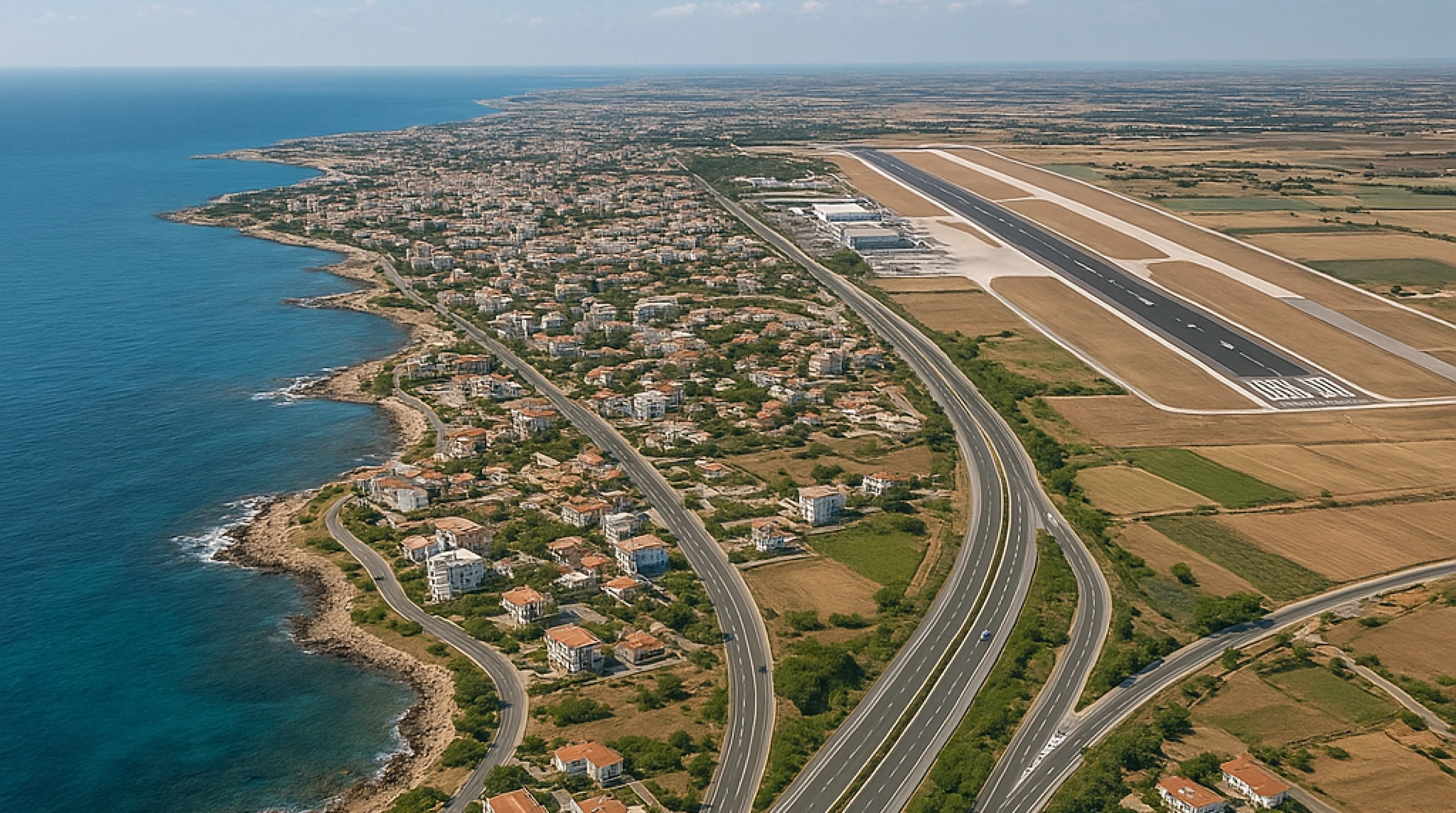
Paphos and Cyprus as a whole are perceived as convenient places for vacation, relocation, and real estate purchases largely due to a clear transportation system: the island is served by two international airports, cities are connected by highways, and buses form the backbone of public transport. It is important to understand the specifics of Cyprus: there is no railway or metro, and outside central areas, the comfort of life is often directly linked to having a car.
Airports of Cyprus: How the Island is Connected to Europe and Other Countries
The main air gateways to Cyprus are Larnaka International Airport and Pafos International Airport. Officially, these are considered the primary international airports of the country and ensure the external transport connectivity of the island. This is particularly important for Paphos: PFO serves the western part of Cyprus and makes the region convenient for tourists, investors, and property buyers who want to arrive without unnecessary ground transfers through Larnaca.
According to Hermes Airports, in 2024, the two airports of Cyprus served 12.3 million passengers, a record figure. For comparison, in 2023, the passenger flow was 11.6 million, and in 2022, it was 9.2 million. For the real estate market, this is a strong indirect signal: the island remains well integrated into international flights, and the transport accessibility of Cyprus is not decreasing but increasing.
It is useful for the article's readers to explain the difference simply. Larnaca usually offers a wider range of destinations and remains the largest aviation hub in the country, while Paphos is particularly convenient for western Cyprus — Paphos itself, Coral Bay, Chloraka, Tala, Peyia, Geroskipou, and neighboring areas. If a person is considering purchasing property specifically in the Paphos region, proximity to the local airport becomes a practical advantage.
Another plus is that the official website of Hermes Airports maintains up-to-date pages for arrivals, departures, and schedules for both PFO and LCA, confirming the stable operation of the airport infrastructure and the convenience of obtaining real-time information.
Roads in Cyprus: Why the Car Remains the Main Mode of Transport
When it comes to moving around the island, roads play a key role in Cyprus. For Paphos, the most important highway remains the A6, which connects Paphos and Limassol and effectively integrates western Cyprus into the overall transport network of the country. This route makes it easier to get towards Limassol and further towards Larnaca and Nicosia.
For future residents and property buyers, there is another practical advantage: there are no toll roads in Cyprus. This means that traveling between cities does not require payment for toll roads or the purchase of vignettes, and the travel system on the island is noticeably simpler and clearer for foreigners.
However, Cyprus has an important feature that must be mentioned in the article: here, traffic is left-sided. For residents of most European countries, this requires some adjustment, especially in the first days after arrival. Official recommendations from Visit Cyprus specifically remind that on the island, one must drive on the left side of the road.
In terms of infrastructure development, it is worth mentioning future projects. The official document from the Public Works Department regarding the Paphos–Polis Motorway describes the modernization of the Paphos-Polis route to motorway standards, with a project target date set for 2031. For the region, this is an important signal: the northwest of the island is expected to gain more convenient road connectivity in the future.
Is There a Metro or Trains in Cyprus?
No, there is no railway and no metro in Cyprus. This is explicitly stated on the official tourist resource Visit Cyprus. Therefore, when it comes to public transport on the island, it is important to understand: its foundation is buses and taxis, not rail transport.
This is why choosing the right location is so important for living in Cyprus. If a person lives in the city center or near key routes, the bus service can cover part of their daily needs. But if it concerns a villa, suburb, hilly area, or a more secluded residential complex, a car offers much more freedom. This point is especially important for those choosing property not just for vacation but for permanent residence.
Public Transport in Cyprus: How the Bus System Works
The official operator, Cyprus Public Transport, provides routes, schedules, trip planning tools, and the Pame mobile app. Through the app, one can build routes, view real-time bus movements, and work with the transport map. This makes the bus system more understandable and convenient than it might seem at first glance.
For the article, it is useful to show the actual cost of trips. According to the official ticket policy of Cyprus Public Transport, effective from March 1, 2026, a single cash ticket on urban routes costs €2.40, while it costs €1.80 with a card. A night ticket from 21:00 to 04:00 costs €4.20 in cash and €2.60 with a card. Passes for 7 and 30 days are also available.
This information is useful for two categories of readers. Firstly, for tourists and potential buyers who want to live in Cyprus for a few weeks and evaluate the area. Secondly, for those considering their living budget and wanting to understand if they can manage without a car at least at the start.
Public Transport in Paphos: Can You Live Without a Car?
In Paphos, the bus system exists and covers basic needs within the city and part of the suburbs. Especially important are the routes connecting the city with the airport. The official website of Pafos Buses indicates route 612 between Tombs of the Kings Bus Station and Paphos Airport. It passes through touristically and practically important points, including Kings Avenue Mall, the city center, Almyra Hotel, Poseidonos Avenue, Geroskipou, Koloni, Achelia, Timi, and the airport. This route operates daily.
There is also route 613 between Karavela Station and Paphos Airport, which also operates daily. This means that getting from the city to the airport without a car is indeed possible, and Paphos is noticeably more convenient in this respect than one might expect from an island city without a railway.
But it is important to maintain an honest presentation. Living in Paphos without a car is possible, but the degree of convenience heavily depends on the area. In the central part of the city, near main routes, shops, and the promenade, the bus logistics are quite functional. In suburban areas and residential complexes outside the center, a car often remains the most convenient option for everyday life. This conclusion logically follows from the transport structure on the island, where there are buses but no rail system, and the road network is oriented towards car travel.
Intercity Communication: How to Get from Paphos to Other Cities
For connectivity with the rest of Cyprus, intercity buses are important. Intercity Buses has active routes between Paphos and Limassol, as well as between Paphos and Larnaca. On the route page for Larnaca—Limassol—Paphos, the estimated travel time is about 2 hours and 45 minutes, while for Limassol—Paphos, it is approximately 1 hour and 15 minutes.
In practice, this means that without a car, it is possible to travel between major cities in Cyprus. However, compared to a personal car or individual transfer, the bus often falls short in flexibility and overall comfort, especially if one needs to adapt to family schedules, trips with children, or property viewings in several areas in one day.
What Buyers of Real Estate in Paphos Should Know
From a real estate perspective, the transportation infrastructure of Paphos looks quite attractive. The region has its own international airport, good connections to Limassol via the A6 highway, regular bus routes to the airport, and intercity bus communication. At the same time, Cyprus remains a country where the quality of everyday mobility largely depends on a car, especially if a person chooses not to live in the city center but in quieter and more private areas.
That is why when choosing a property, it is important to look not only at the sea view or price but also at how convenient it is to get to the airport, supermarkets, schools, medical centers, and main roads. For some buyers, central Paphos with greater pedestrian and bus accessibility will be ideal, while for others, a villa or apartment in a quieter area, where having a car becomes the norm rather than an inconvenience, will be more suitable.
Conclusion
The transportation infrastructure of Paphos and Cyprus as a whole is well-suited for living, vacationing, and purchasing real estate, provided one understands its real logic. The island relies on two international airports, a network of highways, and bus services. Paphos benefits from having its own airport and convenient connections to Limassol, as well as bus routes to the airport and within the region. However, Cyprus is not a country of metros and trains: here, automotive mobility is still particularly valued.
If considering Paphos for relocation or investment, the transportation infrastructure can be assessed as comfortable for island life: it is developed enough to ensure connectivity with the world and the main cities of Cyprus, but the choice of area should still be made with regard to your lifestyle and how important the ability to move without a car is for you.
FAQ
- Which airport is closer to Paphos? The nearest airport to Paphos is Pafos International Airport (PFO).
- Are there toll roads in Cyprus? No, there are no toll roads in Cyprus, making travel between cities more accessible.
- How does public transport work in Paphos? Public transport in Paphos consists of buses that connect the city with the airport and other key points.
- Can you live in Paphos without a car? Yes, it is possible to live in Paphos without a car, but convenience depends on the area of residence.
- What is the cost of bus fares in Cyprus? A single ticket on urban routes costs €2.40 in cash and €1.80 with a card.
May be of interest
In 2026, the property tax system in Cyprus became even simpler and more transparent. This article will detail all the taxes to consider when purchasing property on this island.
This step-by-step guide will help you navigate the process of buying real estate in Cyprus in 2026, from defining your purpose to receiving the keys. Learn how to avoid common mistakes and what expenses to expect.
Buying real estate in Cyprus in 2026 can be safe and profitable if you follow the right steps and work with professionals. This article explores key aspects to help buyers make informed decisions.